Traffic Untangle: Puzzle Roads
Little Whale Game LimitedPuzzle
4.9147.00 Reviews
- Version
- 1.0.22
- Installs
- 500.00K
- Age Rating
- Everyone
Screenshots

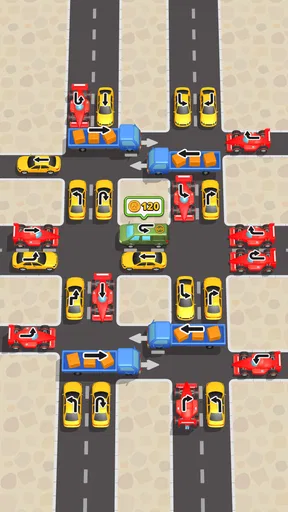
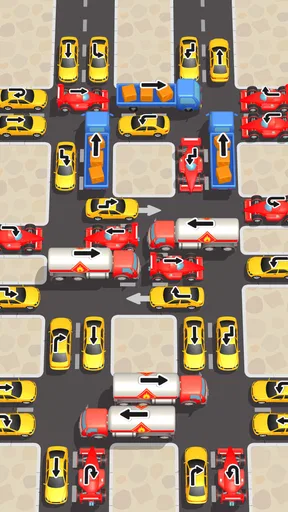

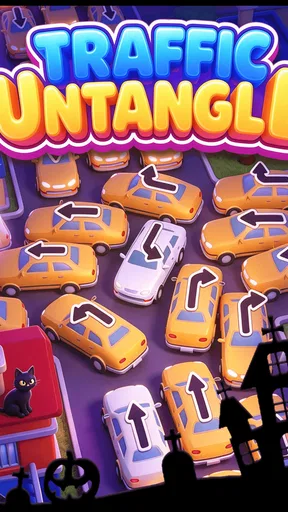
Our Review of Traffic Untangle: Puzzle Roads
 Analysis by Appyee
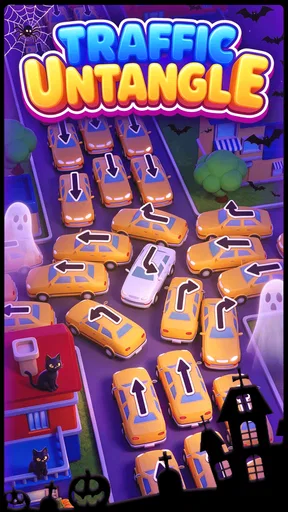
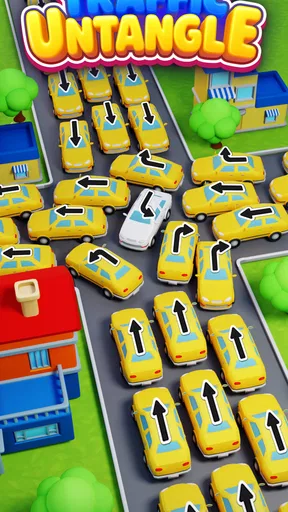
I spent time with Traffic Untangle: Puzzle Roads as a compact 3D puzzle game, and its central appeal became clear very quickly: every level asks me to look at a crowded road arrangement, understand what is blocking what, and find a clean way to release the cars. It is easy to grasp but not automatically easy to solve, which makes it a comfortable choice for short breaks and a surprisingly absorbing option when I want something more thoughtful than a reflex game.
The presentation is built around a simple idea rather than a large story or complicated rule set. I am not managing a city, racing against opponents, or collecting a cast of characters. I am solving traffic knots. That focus helps the game feel approachable, especially for players who prefer visual puzzles with immediate goals. At the same time, the three-dimensional view means I need to inspect the arrangement instead of relying only on a flat, obvious path.
Little Whale Game Limited keeps the experience centered on that puzzle loop. The game is free to download, rated for Everyone, and listed in the puzzle category. It has reached over five hundred thousand installs and holds a 4.9 average from around 5.8 thousand ratings, which suggests that the basic format has found an audience. I would still treat those figures as a starting point rather than a guarantee: this is a focused game, and whether it suits you depends heavily on how much you enjoy untangling layouts one decision at a time.
How the first goals establish the game
The opening stages do a useful job of teaching through action. Instead of making me study a long explanation, the early puzzles point toward the main question: which vehicle needs to move first, and which movement will create room for the others? That is a good fit for a mobile game because I can understand the objective almost immediately and begin experimenting without a large learning barrier.
My first instinct was to move the most visible car, but the better approach was often to examine the whole arrangement before touching anything. A vehicle that looks ready to leave may be trapped behind another route or may occupy the space needed by a different car. This creates an early lesson that remains useful later: the puzzle is less about speed than about order.
That distinction matters. Some mobile puzzle games make the first minutes feel like a tutorial that plays itself. Here, the early goals are simple enough to invite confidence, but they also encourage me to notice dependencies. I began checking exits, blocked lanes, and the positions that would become available after one move. Even when a level was straightforward, it established habits that made later layouts easier to read.
The game works particularly well for someone who wants a clear task during a short pause in the day. I can open it, solve a small number of traffic arrangements, and stop without needing to remember a complicated narrative or a long chain of objectives. In a waiting room or during a commute, that self-contained structure is more convenient than a puzzle game that expects a lengthy session.
There is also a useful psychological rhythm in the first part. A successful move changes the board visibly, so progress is not hidden behind menus or abstract points. I can see that a lane has opened or that a vehicle has become reachable. That visual response gives each decision a little weight, even when the level itself is not especially difficult.
What I learned by reading the board before moving
The most reliable early technique was to pause for a few seconds and trace the possible routes mentally. I looked for the vehicle that was least restricted, then considered whether moving it would help another car or simply create a new obstruction. This is more effective than tapping through random options, and it also makes the game feel more like a logic exercise than a trial-and-error toy.
A second useful habit was to avoid treating the nearest exit as the only priority. The best first move is not always the car closest to freedom. Sometimes a vehicle in the middle of the arrangement controls the space around it, so releasing that one first can simplify several later decisions. That relationship between local movement and overall layout is where the three-dimensional design earns its place.
I also found that solving a level mentally before committing to a move is not always necessary. When the arrangement is open, a little experimentation can reveal the intended order quickly. The trade-off is that careless moves may make the board harder to read, so I preferred deliberate testing once the layouts became denser. Players who enjoy planning will appreciate this, while players who want constant action may find the pauses less exciting.
Progress signals and the feeling of moving forward
The progression is communicated mainly through the puzzles themselves. Each completed arrangement gives me a clear sense of closure, and the next challenge provides a reason to continue. That direct connection between solving and advancing is stronger than a reward system that distracts from the actual puzzle. I always knew what I had accomplished because the traffic was no longer tangled.
What kept me interested was not a large collection of unrelated activities, but the gradual change in how I had to inspect the board. Early levels let me focus on individual vehicles. As the arrangements become more involved, I needed to think about the consequences of several moves in sequence. The progress signal therefore comes from my own growing understanding as much as from reaching the next stage.
This is an important strength for a puzzle game with a narrow premise. If every level used exactly the same mental step, the traffic theme would wear thin quickly. The better moments came when a familiar-looking layout hid a different dependency. I might recognize the general goal but still need to rethink the order because one apparently harmless move disturbed the space required later.
I would not describe the progression as a substitute for a broad adventure game. There is no need to expect a rich story, character development, or a large world to explore. The reward is the satisfaction of clearing another arrangement and seeing myself become more efficient at spotting the solution. That makes it a good match for players who measure progress through mastery rather than collection.
The game is currently listed as version 1.0.22 and requires Android 7.0 or later. For someone deciding whether an older Android phone can run it, that operating-system requirement is the practical detail to check first. On a compatible device, the simple premise should be easy to understand, but the visual layout still benefits from a screen where the vehicles and routes are comfortable to distinguish.
Why the progress feels visible even without overcomplication
I liked that the game does not need a complicated score screen to make a solved level feel meaningful. The board itself is the feedback. When a vehicle moves into a previously blocked area, the arrangement changes in a way I can immediately evaluate. That makes the puzzle readable and helps me connect each successful decision with the result.
There is a subtle advantage to this approach when playing in short sessions. If I stop after completing a level, I finish at a natural point rather than leaving a long mission half-done. If I return later, I can begin with a fresh problem instead of reconstructing a story or remembering a complicated inventory. That makes the game more practical for casual use than many larger puzzle adventures.
The limitation is that players who need a strong external reward may eventually want more variety than the core loop provides. I found the internal satisfaction enough when the puzzle made me rethink my assumptions, but a person who plays mainly for collectibles, dramatic unlocks, or narrative surprises may not feel the same pull. The game’s progress is strongest when the act of solving is already rewarding to you.
Difficulty curve: from obvious exits to careful sequencing
The difficulty curve works because the game first teaches me to recognize the basic traffic relationship, then asks me to apply it under more pressure from the layout. The challenge is not based on twitch reactions. It comes from identifying which movement preserves options and which movement closes them. That keeps the game accessible to people who are comfortable with logic puzzles but may not enjoy fast arcade controls.
My main advice is to resist the urge to make the first available move simply because it is available. In an easy arrangement, that may work. In a tighter one, it can create a misleading sense of progress while leaving the real bottleneck untouched. I had better results when I searched for the vehicle or lane that was limiting the rest of the board.
Another practical technique is to divide the arrangement into small relationships. I would first identify which cars affected the central space, then check which vehicles depended on that space becoming clear. This reduced the visual noise of a crowded board. It also helped me avoid planning a long chain all at once, which can be mentally tiring when several routes appear possible.
The three-dimensional view adds both clarity and friction. It helps separate objects spatially and gives the puzzle a more tangible feel, but it can also make a crowded scene take longer to read than a clean two-dimensional grid. I sometimes needed to adjust my attention and inspect the whole arrangement rather than focusing on one vehicle. Players who prefer perfectly abstract boards may find the visual presentation less immediately precise than a traditional tile puzzle.
That trade-off is central to the experience. The game is not merely a logic diagram with cars pasted on top; the traffic setting influences how I interpret space and movement. For me, that made the puzzles more inviting. For someone who wants mathematical certainty at a glance, the extra visual layer may feel like an obstacle instead of an enhancement.
When to experiment and when to restart your thinking
Experimentation is useful in the simpler layouts because a single move can reveal the intended structure. I did not need to calculate every possibility before acting. However, once the board became crowded, random movement became less productive. At that point, I found it better to stop, identify the blockage, and rebuild the solution from the earliest dependency.
This creates a nice middle ground between passive solving and blind guessing. I could use the game as a calm thinking exercise, but I could also play more casually by testing an idea and learning from the result. The best style depends on the player. Someone who enjoys perfect solutions may want to plan carefully, while someone seeking a relaxed diversion may prefer to explore and accept a few wrong turns.
The game is less suitable for players who want a difficulty curve built around rapid timing, enemies, or constant sensory stimulation. Its challenge is quiet and spatial. If your ideal puzzle game is a word game with quick rounds or a match-based title with immediate combos, this may feel slow. If you enjoy rearranging, sequencing, and spotting hidden dependencies, the pace is much more comfortable.
What keeps the loop going, and where it may lose pressure
The strongest retention pressure comes from the feeling that the next arrangement might introduce a fresh twist on a familiar idea. I often continued because I had just solved a difficult traffic knot and wanted to see whether the next one would demand a different order. That is a healthy kind of motivation: the puzzle itself creates curiosity instead of relying only on interruptions.
At the same time, a focused loop can become repetitive if the layouts stop asking new questions. The game’s long-term appeal therefore depends on how much variation a player perceives between stages. I enjoyed it most when I had to change my reading strategy, not when I could repeat the same obvious sequence with a different arrangement.
The free entry point makes it easy to test that relationship for yourself. You can see whether the early puzzles hold your attention before deciding how much time you want to invest. In-app purchases range from $0.99 to $99.99 per item, so I would approach the optional spending carefully and treat the free portion as the real test of fit. A puzzle game should remain enjoyable because the solving is satisfying, not because the player feels pushed to pay to maintain momentum.
That is also where I would set expectations for families. The Everyone rating makes the game broadly approachable, and the traffic theme is easy for younger players to understand. Still, a child who becomes frustrated by planning several moves ahead may need encouragement to slow down rather than tap randomly. An adult can enjoy the same levels as a short mental break, but the appeal is thoughtful rather than competitive.
For daily use, I found the game most effective as a transition activity. I could play a few levels after finishing work, while waiting for food, or before switching to another task. It gave me a defined mental problem without demanding a large time commitment. I would not choose it for a party or group setting, because the satisfaction comes from private concentration rather than shared interaction.
Who should choose it and who should look elsewhere
I would recommend this game to anyone who likes visual logic puzzles, wants a simple mobile activity with clear objectives, and enjoys improving through observation. It is especially appealing if you like the idea of a puzzle that can be understood in seconds but still rewards careful sequencing. The traffic setting gives the familiar “move things out of the way” concept a more concrete shape.
I would be more cautious about recommending it to players who need a strong narrative, competitive rankings, or a wide range of mini-games. It is not trying to be a complete entertainment platform. Its identity is tied to untangling vehicle arrangements, and that focus is both its charm and its boundary.
I would also choose a more traditional grid-based puzzle if I wanted maximum visual precision or a system built around numbers, words, or fixed tiles. Those alternatives can make relationships easier to calculate. I would choose this game instead when I wanted the same kind of reasoning presented through a more physical-looking scene, where clearing one route changes the shape of the entire problem.
My progression verdict after playing through the core loop
Traffic Untangle: Puzzle Roads succeeds when it asks me to turn a messy road arrangement into an ordered plan. Its early goals are accessible, its progress is easy to read, and its difficulty becomes more interesting when I stop treating each vehicle as an isolated object. The most valuable skill is learning to protect future options rather than celebrating every immediate movement.
Its pacing is best for players who enjoy measured challenge. I never needed frantic reactions to understand what was happening, but I did need patience when several vehicles competed for the same space. That makes it a good companion for short, quiet sessions and a less convincing choice for anyone seeking constant action.
Little Whale Game Limited has built a puzzle experience with a clear center of gravity. The free price lowers the barrier to trying it, the Everyone rating keeps the concept broadly approachable, and the current version, 1.0.22, gives Android users a straightforward compatibility point to check. With over five hundred thousand installs, it is already more than an obscure experiment, though its appeal remains specific rather than universal.
My final recommendation is positive, with one condition: choose it for the act of solving, not for a large collection of unrelated rewards. If you enjoy examining a board, testing a sequence, and feeling a knot loosen one decision at a time, this game can become an easy title to return to. If you need dramatic unlocks, story-driven progression, or fast competition to stay interested, the focused traffic-puzzle format may not sustain you for long.
For me, the best reason to keep it installed is the small but satisfying shift in perspective it encourages. I start by seeing a pile of cars and blocked routes. After a moment of careful inspection, I begin to see dependencies, openings, and a possible order. That change from visual confusion to a workable plan is the game’s real reward.
Verdict
Strengths of Traffic Untangle: Puzzle Roads
- Simple controls make it easy to start playing immediately.
- Short levels are ideal for quick sessions on the go.
- Increasing complexity keeps the puzzles engaging over time.
- The traffic theme gives familiar logic puzzles a distinctive setting.
- Offline play makes it useful when you have no internet connection.
Limitations of Traffic Untangle: Puzzle Roads
- Some levels can feel repetitive after extended play.
- Later puzzles may rely more on trial and error than logic.
- Hints or extra moves may be limited or tied to monetization.
- The game may offer little appeal once all puzzles are completed.
- Ads can interrupt the flow between levels.
Other Releases by Little Whale Game Limited
View All
Traffic Frenzy: Road Jam
Puzzle4.8
Similar Picks in This Category
View All
Block Blast!
HungryStudio4.8

Braindom: Brain Games Test
Lahana Game Studio4.6

AMAZE!
CrazyLabs LTD4.6

Sudoku - Classic Sudoku Puzzle
Oakever Games4.7

Art Puzzle - Puzzle Games
Easybrain4.8

Amaze GO!
Oakever Games4.9
Frequently Asked Questions
What is Traffic Untangle: Puzzle Roads, and how is it played?
Traffic Untangle: Puzzle Roads is a logic puzzle game centered on reorganizing tangled traffic routes. Your objective is to clear intersections and guide vehicles through the road network without creating collisions or blocking other cars. Gameplay generally involves tapping, moving, or changing the order of vehicles and roads, with each level becoming more complex as new layouts and obstacles are introduced.
Is Traffic Untangle: Puzzle Roads free to download and play?
The game can typically be downloaded for free, allowing players to access its main puzzle content without an upfront purchase. However, free versions may include advertising, optional in-app purchases, or paid items that help remove ads or provide additional assistance. Before downloading, check the store listing on your Android or iOS device for the current pricing, purchase details, and available payment options.
Does the game require an internet connection?
Traffic Untangle: Puzzle Roads is designed as a casual puzzle experience, so many of its levels may be playable without a constant internet connection. Nevertheless, an internet connection can be required for advertisements, analytics, cloud features, updates, or restoring purchases. If you plan to play offline, download the game and open several levels first to confirm which features remain available without mobile data or Wi-Fi.
Is Traffic Untangle: Puzzle Roads suitable for children?
The simple controls and visual traffic puzzles can make Traffic Untangle: Puzzle Roads accessible to children, while the increasing difficulty also gives older players a reason to continue. Parents should still review the age rating, advertising content, and in-app purchase settings before allowing unsupervised play. Some levels may require patience and planning, particularly when several vehicles must be moved in a precise sequence.
Are there hints, extra lives, or other assistance when a puzzle becomes difficult?
When a level feels difficult, the game may offer assistance such as hints, resets, retries, or other progression tools, depending on the version installed. These features can make challenging layouts easier to solve, but they may be limited or connected to advertisements, earned rewards, or optional purchases. Try restarting the puzzle and studying the vehicle order before spending any available hint or bonus.
Play our best games!


